convert-png-to-jpeg
convert to png
JPG vs JPEG: Understanding the Most Common Image File Format
Website owners face image files frequently. While you don't need be an expert on image files to edit or upload images on websites it is important to familiarize yourself with the most common formats for files such as JPEG. Or is it JPG?
In this article, you'll see an JPG comparison with a JPEG showdown so you understand the differences as well along with other tips to enable you to upload the finest images you can to your website to provide the best user experience. If your looking for an in-depth overview of the modern .webp format and how to use it, we've got that covered too.
Ready? Let's get started!
Table of Contents
- What is JPEG?
- What is JPG?
- JPG vs JPEG: Similarities Between the Two
- JPG vs JPEG 2000
- Convert Image Files to JPG: Common Methods
convert to jpeg
As a webmaster who works with images, you've probably seen an image file in the format JPEG on occasion during the process of editing and uploading.
But did you be aware that the word JPEG really is a reference to three different things?
Well, it is and we're here to explain all of them:
1. JPEG Lossy Compression
When you upload images to your site it is essential to take care not to negatively affect the speed of your site and performance by using big images that consume a lot of resources and take forever to display on the front end of your website. In reality, all site administrators should optimize their websites in a way that reduces the size of their pictures and maintain loading times and the user experience.
That's why JPEG can come in handy. JPEG is a lossy compression method used to ensure that digital images being used are as small as is feasible and loaded quickly in the event that someone would like to see them.
Here are a few points to keep in mind about lossy compression:
- The size of an image being compressed is always reduced by eliminating any unnecessary ( redundant) informationfrom the image.
- Quality of the images is a concern, though it's often so subtle that the average visitor can't tell.
- During the compression process, each pixel is compared to the pixels around it in a ratio of 2:1 all the way to 100:1 ( any pixels that have the same characteristics as the original are deleted because they're deemed unneeded).
- JPEG lossy compression is generally employed for photographsand more complex still images.
- Once you have compressed an image with lossy compression, it determines how big the file is and what value trade-off ( e.g., smaller files = poor image quality).
- As much editing and saving an image the less quality of the image will be.
If you're more experienced in editing images using lossy compression, there's an opportunity to save the image's quality and reduce the size of the file through working with RAW JPEG images as well as editing them and saving the image one time.
convert to BMP
If you're not sure whether you want to implement JPEG lossy compression on the images of your website it's possible to use the alternative: lossless compression.
The lossless compression method saves your images in an entirely distinct format ( usually PNG). Although the quality of your image is never sacrificed because there is no information is lost, be aware that using lossless compression, the final file measurement of your images will always be larger than with lossy compression. This could result in slower page loading times.
2. Joint Photographic Experts Group (JPEG)
JPEG stands for the Joint Photographic Experts Group, it is the name of the sub-committee responsible for the creation of the JPEG standard in addition to other standards for still pictures in the larger ISO group. ISO.
The first JPEG standard was published as of the year 1992. ISO ( International Organization for Standardization). ISO are responsible for drafting specifications designed to "...provide requirements standards, specifications, guidelines or features that are used consistently to ensure that the quality of products, materials processes as well as services are suitable for purpose."
ISO sets standards for many things including digital imagery, with the aim of providing customers and users with the highest-quality products and solutions. 
Image source: Wikimedia Commons
The International Organization is a voluntary group of people with members from over 164 different countries, making it one of the biggest developers of standards.
3. JPEG as a File Format
The third way JPEG is employed is when it refers to a name for a file format or a way to store the digital image. This is most likely how people are most familiar with JPEG because this is one of the formats for file options when you store an image that you've altered. 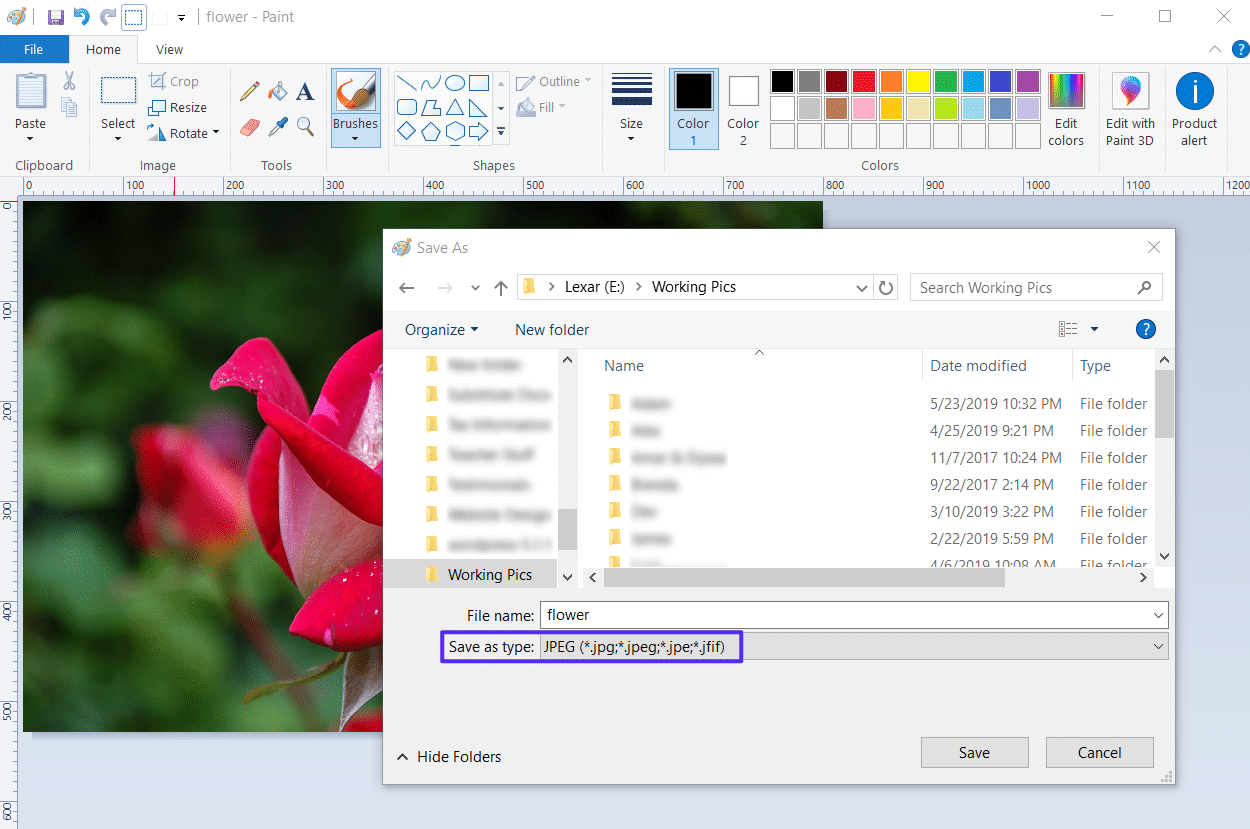
JPEG file format
Here are some interesting facts about The .jpeg file format:
- Most commonly used image file standard used by DSLR cameras and other image capturing devices.
- Colors are supported by 16,777,216. They can be created using 8 bits of each RGB colour model.
- It can display up to 16 million hues simultaneously The design of the color palette and resolution close to perfect.
- Supports a maximum size of 65,535 x 65,535 pixels.
- This reduces the dimension of images by about 50-75% ( because of lossy compression) when saved
In addition, this file format is not ideal for images with sharp edges since it blends colors more than if it were saved in a .png that displays distinct pixels as a group.
Now, let's figure out what JPG is.
What is JPG?
What in the world is JPG relative to JPEG? 
Extensions for files in Windows
If you're looking for a way to compare to .jpeg vs .jpg, the truth is there's nothing different between the twoexcept the amount of characters.
Crazy right? Let us explain.
The term JPG was created by the earlier versions of Windows operating systems. Specifically, the MS-DOS 8.3 as well as the FAT-16 systems had a maximum 3-letter limit in name of the file, in contrast to more UNIX-like operating systems, like Mac or Linux, which didn't have this limit.
Also, on Mac as well as Linux systems images that were saved as JPEGs utilized the extension .jpeg. However, when saving the same kind of images using Windows, the file extension was required to be reduced to .jpg so it didn't exceed the 3-letter limit.
Nowadays, Windows operating systems accept files with 3- or 4-letter extensions such as .jpeg as well as .jpg. However, because so many people use Windows for so long, and are used to saving their images as JPGs and JPGs, they've not stopped. Because of this, applications for photo editing like Adobe Photoshop and GIMP save all JPEG images in default to the .jpg file extension on as well Windows or Macs to prevent confusion.
JPG vs JPEG: Similarities Between the Two
You're aware there's a difference between .jpeg and .jpg files are the exact similar thing. But to help drive this idea home and ensure you remember it long into the future, we're going to take a look at the similarities between JPEG and JPG images.
1. Both Are Raster Images (Not Vector Images)
Computer-generated images can be constructed in raster or vector formats. Because JPEGs can be described as raster images, then so are JPGs.
Graphics called bitmaps are images. A bitmap is a grid made up of individual pixels that when merged create an entire image. In this way, raster image comprise a variety of miniature squares ( or pixels) of color that are all coded in a certain shade or hue. When taken together create an image that makes sense to take a look at. 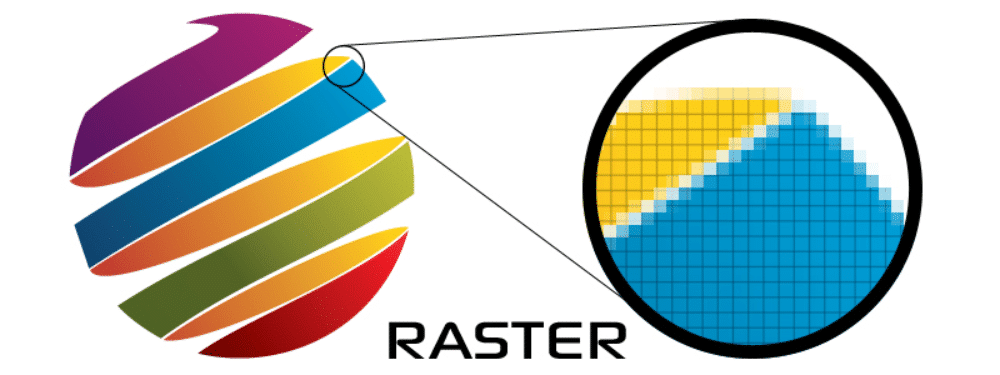
Image source: PrintCNX
Here's more information on raster images that will aid you in understanding:
- Most suitable for images with no lines like photographs or scans of artwork or images with a lot of detail.
- They have subtle hue or shade gradations and very undefined lines and forms.
- Due to their pixels-based nature, they face quality issues when they're blown in size ( they become jagged and reveal the individual pixels).
- They are defined and displayed in a specific resolution. It is expressed in dots/in ( dpi).
- The greater the dpi, better the resolution as well as the visual attractiveness of images.
- Common raster file formats include: TIFF, JPEG, GIF, PCX and BMP files.
- Images in the Raster format make up standard on the Web standard, which implies that they are preferred for all images you can find on the internet.
For the record, JPEGs or JPGs are not vector images. 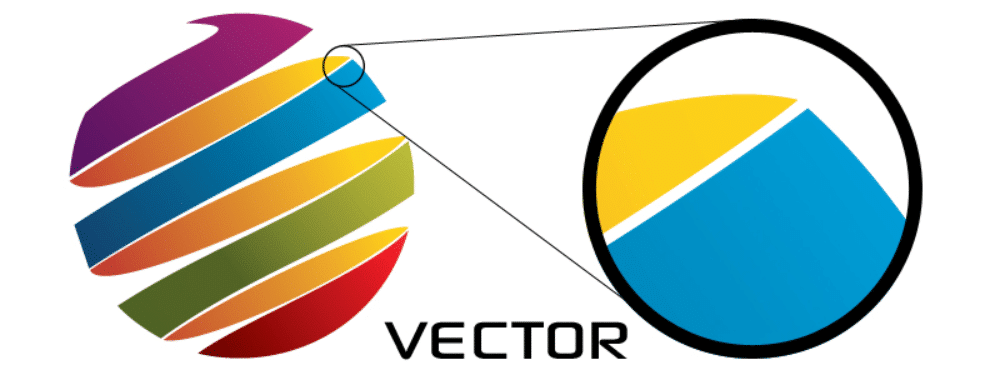
Image source: PrintCNX
Here's some information regarding vector images, so you'll know the difference:
convert-to tiff
Want to know how we increased the amount of traffic we receive at a rate of 1000%?
Join more than 20,000 people who get our weekly email with insider WordPress advice! Sign up now!
- Images are based on mathematical formulas that define geometric shapes , such as lines, polygons curvatures, circles and rectangles.
- Perfect for straight-edged images like line art.
- Because there are no color gradients, they are great for flat photographs that are uniformly colored.
- Use popular images such as letters, logos, and fonts.
- You can scale down or up without any quality loss because they don't rely on pixels to make the image complete.
2. Both Terms Mean the Same Thing
Did you remember when we talked about the term JPEG and how it stood in reference to the Joint Photographic Experts Group? Yes, you read it; each JPEG as well as JPG are abbreviations of that same ISO sub-committee.
3. Both Are Used for the Same Image Types
Since they are raster photos which are not vectors neither .jpeg and .jpg format files are most suitable to be employed for digital photography. Digital photographs include a lot of color gradations that appear seamless when saved as raster JPEG/JPG images. The visitors on your website will always see a beautiful image if it's saved in a .jpeg/.jpg file and then uploaded to your site.
Learn more about image files types and the impact they have on your website.
4. Both Lose Some Quality When Saved
Because the .jpeg against .jpg comparison is null ( because they are exactly the same), it is reasonable that the compression technique used for each format of file -- lossy compression-- will result in a decline in image quality when the size shrinks.
Additionally, this means that regardless of the extension you choose to use ( either .jpeg or .jpg), your image's file size will be smaller than what it was when it was first created, which will lead to more speedy loading when uploaded to your website and seen by visitors to your site.
In the final analysis, JPEGand JPGs are the same and serve several main functions that are to decrease the size of images for better web browsing and give users an easy method to compress their images on saving. Then, name the image with a standard file extension that is known by a lot of.
So ask yourself: JPG vs JPEG Which is superior? From there, do not think too much because the answer is neither. They're the exact same thing, which one you pick is simply a matter preference.
JPG vs JPEG 2000
If you've ever been seeking information regarding JPEGs and JPGs, you may have encountered the term JPEG 2000and thought about what in the world it was. Since it's an option available in the majority of photo editing programs.
JPEG 2000 was an image encoder created by the Joint Photographic Experts Group in 2000 that was designed to be better than the JPEG standard already in place. In fact, it was created to implement lossless compression on Images made using modern compression techniques on a discrete wavelength transformation.
If you're uploading lots of images and photographs to your website, then you don't wish to render pages that are slow to visitors, right? Our servers are lightning fast and 24x7 support by WordPress experts. Look over our plans
It provided people with a method to boost their images and save the images in JPEGs, without degrading the quality of the image.
Here are some of the top features to be found in JPEG 2000:
- advanced Compression Techniques:unlike conventional JPEGs, JPEG 2000 was able to perform both lossy and lossless compression ( even on a single image file).
- Progressive Decodingenables site visitors to see the lower quality version of an image while the entire image is still being downloaded on the background. As more data is downloaded, the quality of images improves for the user.
- Higher Compression Ratios:when it concerns lossy compression JPEG 2000 will compress an image as much as 20-200 percent higher than JPEG, while maintaining the same image quality compared to JPEG. JPEG image with the same dimensions.
Furthermore, JPEG 2000:
- Helps preserve transparency in images.
- It can describe grayscale, bi-level, palette-color, and full-color image data.
- The metadata includes unlimited quantities of private or specific-purpose information in metadata.
- It can handle larger sizes of images ( greater than 64K pixels) without tilting.
- Ultra-low latency is especially beneficial to stream live TV.
- Scalability, both in resolution and quality.
JPEG 2000 Limitations
Although JPEG 2000 is packed with excellent features and is believed to be the next most efficient quality digital image coder however, there are some reasons it's not yet one of the file formats that is popular with most people:
- There is no universal browser support ( only supports Safari).
- Incompatible for JPEG ( must encode the new standard, and also support the original JPEG).
- Coding JPEG 2000 files can be processing intensive for CPUs, which can cause server strain and cause slowdowns.
- A lot of cameras and websites are not ready to accept the format , because it's still not universally accepted.
Due to its limitations you'll find it difficult to find the JPEG 2000 file format as an option when saving your digital photos. And while it is arguably superior to JPEG, until it is accepted by everyone as a standard, you'll likely bump into a host of compatibility issues that make your job as a webmaster than it needs to be.
Convert Image Files to JPG: Common Methods
There are many options to save your digital photos as .jpg as well as .jpeg files. We'll look at a few.
1. Windows Paint
If you are running Windows, you can easily save any image in .jpeg or .jpg using Windows Paint. Upload your image into Windows Paint, go to the File> Save As Select the location of the file, then name your image, and then choose JPEG (*.jpg, *.jpeg, *.jpe, *.jfif)from the drop-down selection. 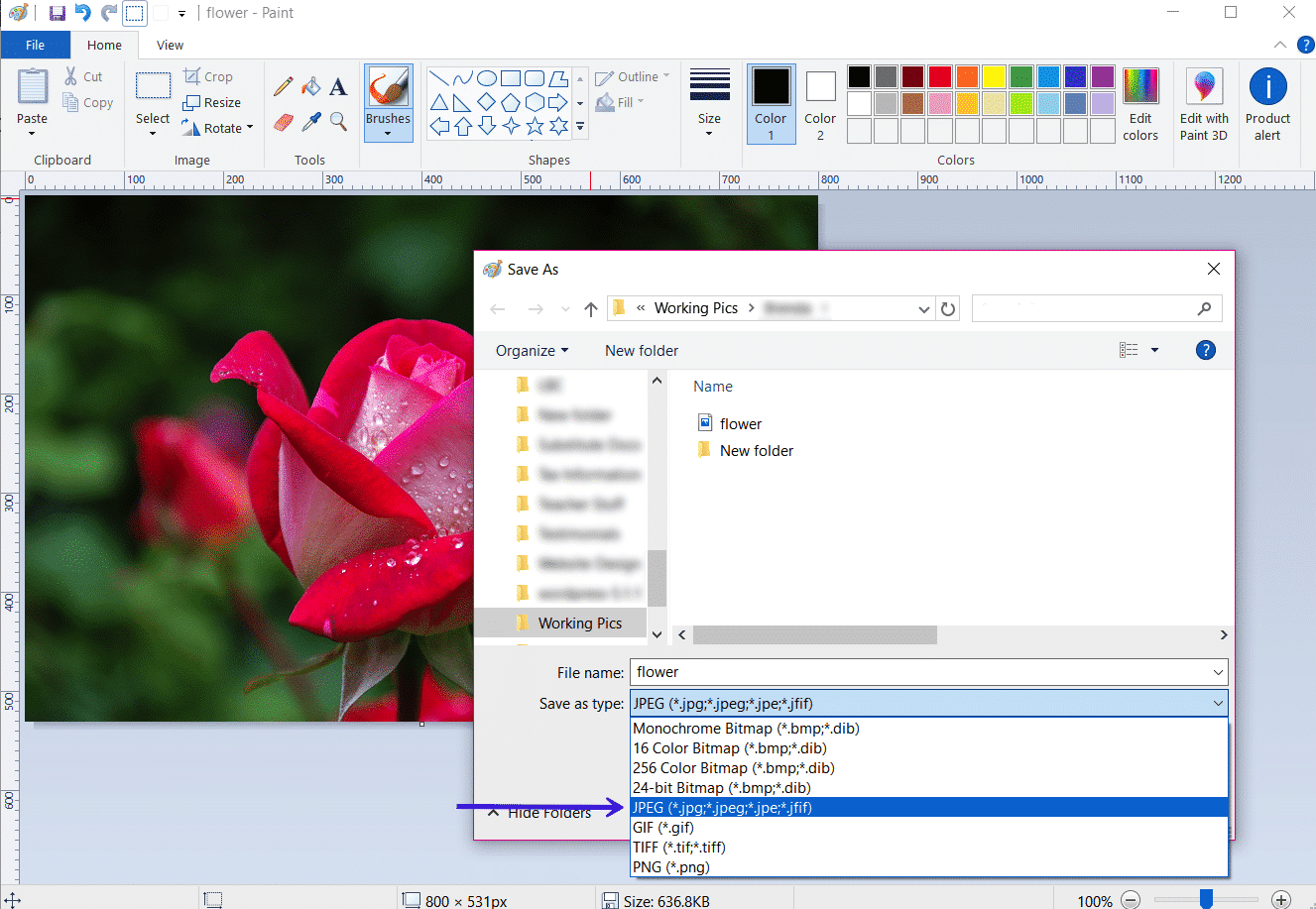
Windows Paint
Click Save.
2. Affinity Designer
Affinity Designer is similar to other image-editing software such Adobe Photoshop. To save your image as JPG, you must first save it as JPG using a software like this, you must first open the application and uploading the image. Make any adjustments you'd like and click "File"to export.... Select from the JPEG icon, choose your preferred quality ( best, high medium, low or best) and click Export. 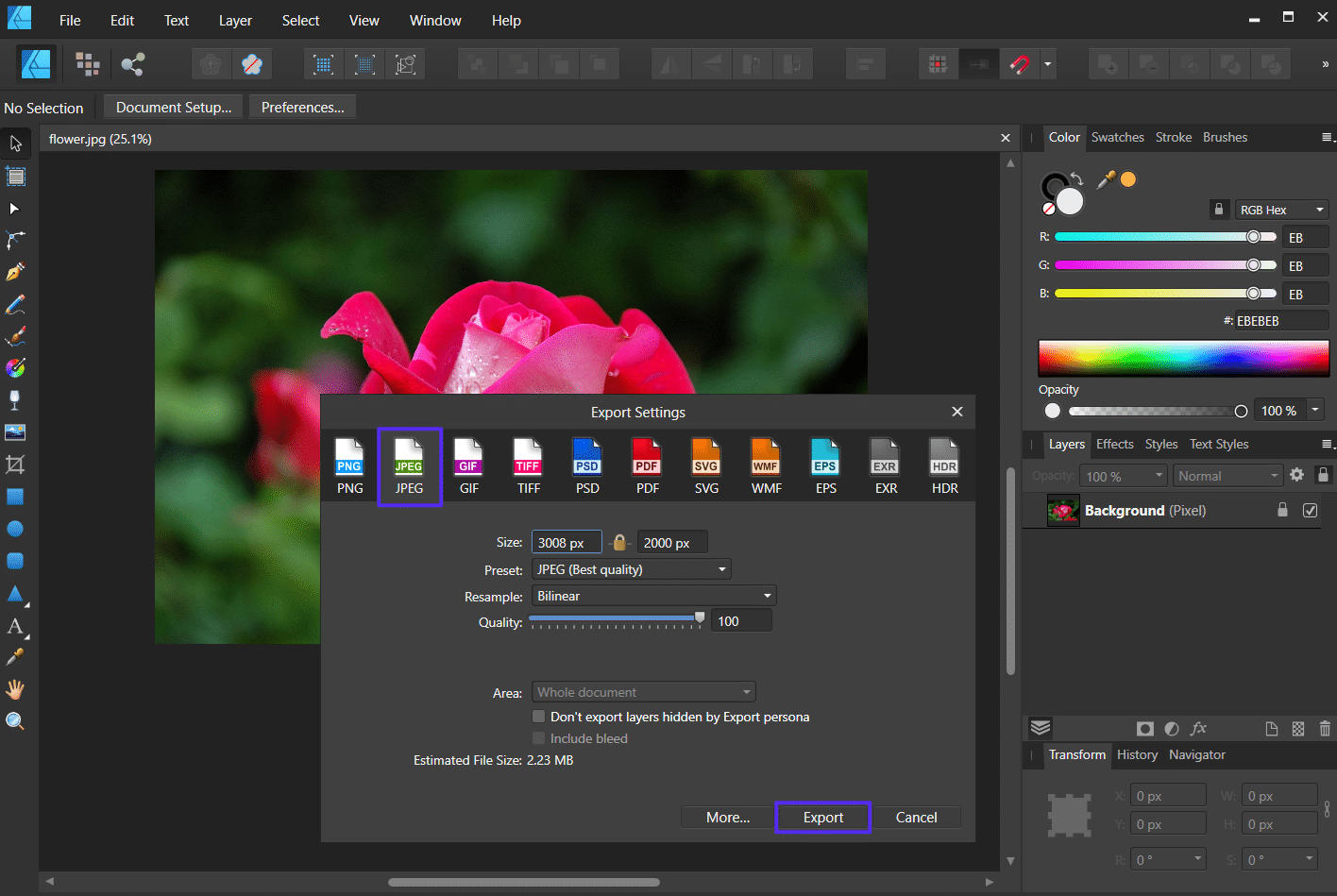
Affinity Designer
If you do this, the Saving As dialog will appear so that you can choose a file destination, name your image and verify that you save the file as JPG. 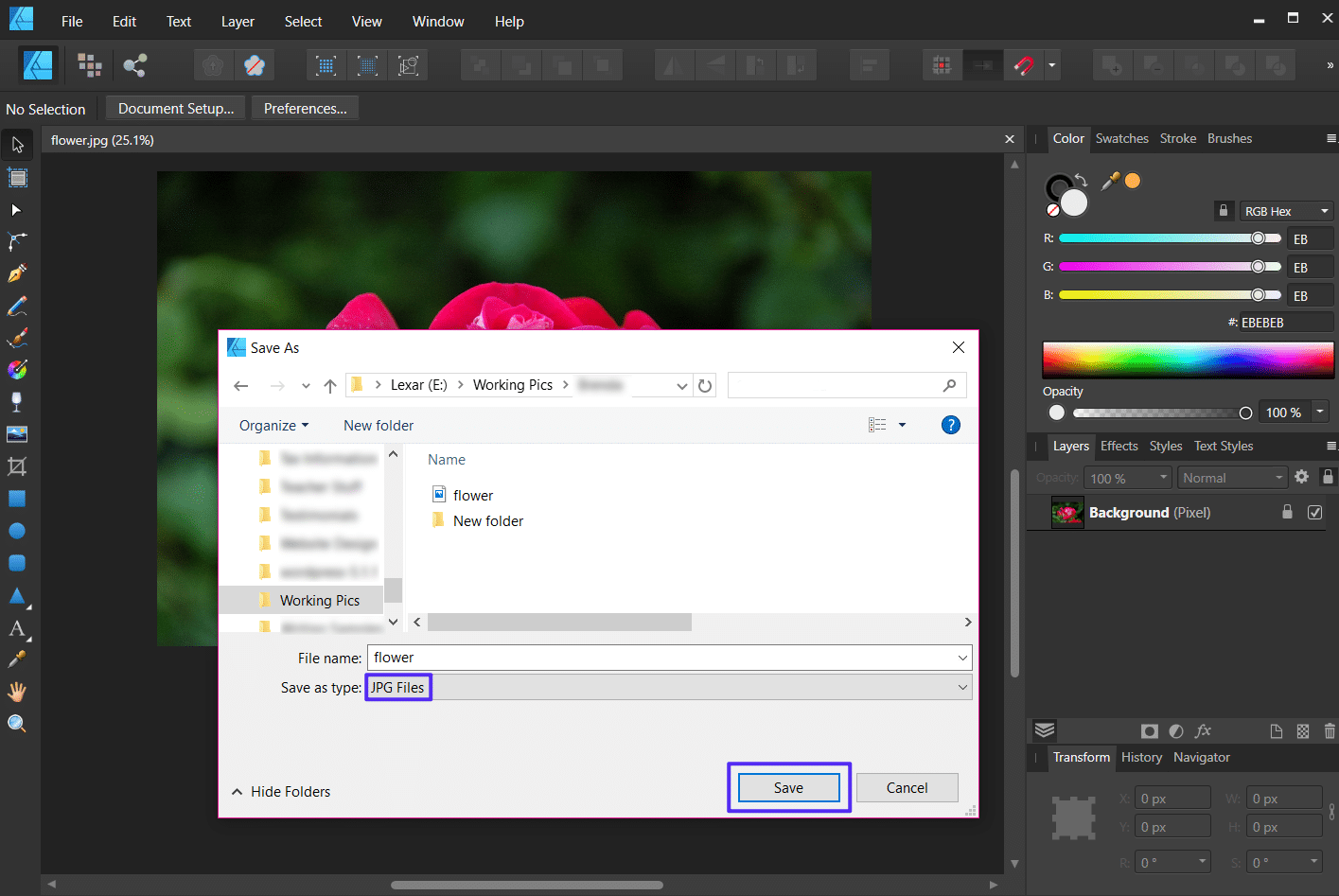
"Save as" in Affinity Designer
Click Save.
3. Online Converter Tool
If you want to convert images to JPG There are a number of free online tools for converting images to JPG to help. For instance, FileZigZag is a free online converter for files that is easy to use. Simply drag and drop an image file or upload the file select the type of file for conversion Enter an email address and click "Convert.". 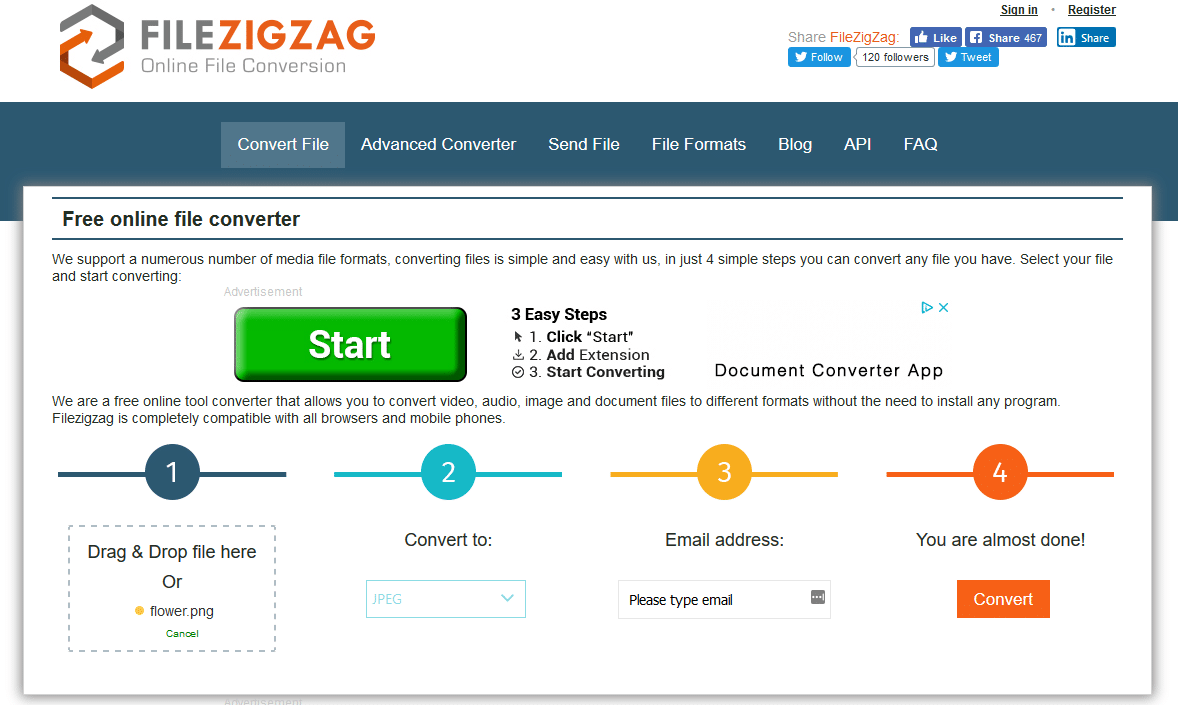
Convert png to JPEG FileZigZag
Naturally, you'd not want to hand over your email address in exchange for making your image a JPG. This is why we've listed various other premium and free options for you to check out:
- XnConvert : perfect for advanced image editors that require a variety of image file formats, the capability to bulk convert, and the option to run Windows, Mac, or Linux.
- Zamzar :a free online tool for those with massive image files ( up to 50MB) who would like the option of having the end result emailed or not.
- Adapter : a simple image converter , which can work with batch images. It can convert them instantly and is compatible with both macOS and Windows.
Of of course, these are only some of the available choices you can select if need to convert your images to JPG.JPG is not the same as JPEG: What's the difference? What's the difference between JPEG 2000 and JPEG 2000? Get the answer (and more) with our extensive guide! CLICK TO TWEET
Summary
JPG in contrast to JPEG are the most commonly used options for file extensions and compression for people who want to store or save images in digital format. This is especially important for website owners that want to showcase visually appealing images while ensuring a high-quality user experience.
There's good news for you: no matter whether you prefer .jpeg, .jpg or .webp kinds of files, you'll to experience the same effect: beautiful images that load extremely fast for site users.
Lower costs, time and increase site performance:
- Support is instant Assistance from WordPress experts in hosting, 24 hours a day.
- Cloudflare Enterprise integration.
- Global reach for the public with 28 data centers in the world.
- Optimization using Built-in Application Optimization with our built-in Application.
All of that and much more, in one plan with no long-term contracts, assisted migrations, and a 30-day-money-back-guarantee. Review our plans below or talk to sales to find the best plan for you.
use this tool >> compress image
Comments
Post a Comment